
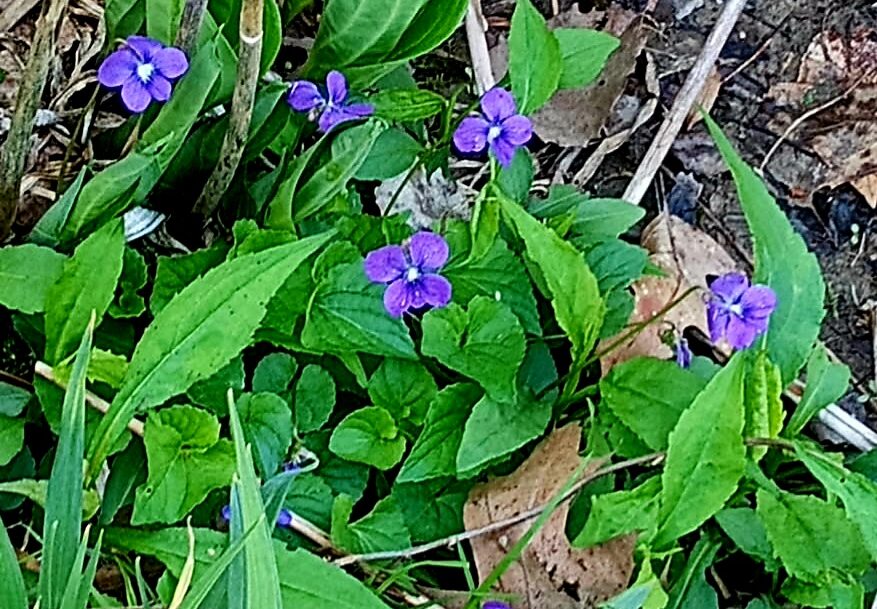
At first, I thought there wasn’t much I could blog about on wild violets. However, when a Reader sent me a photograph of a lovely patch of wild violets, I decided to do a bit of research on the topic. And here we go with the interesting results.
Wild Violets Facts
Wild violets are usually one of the first flowers to come up in the spring typically in April or May. They play an important role in helping feed pollinators at a time there are few flowers about.
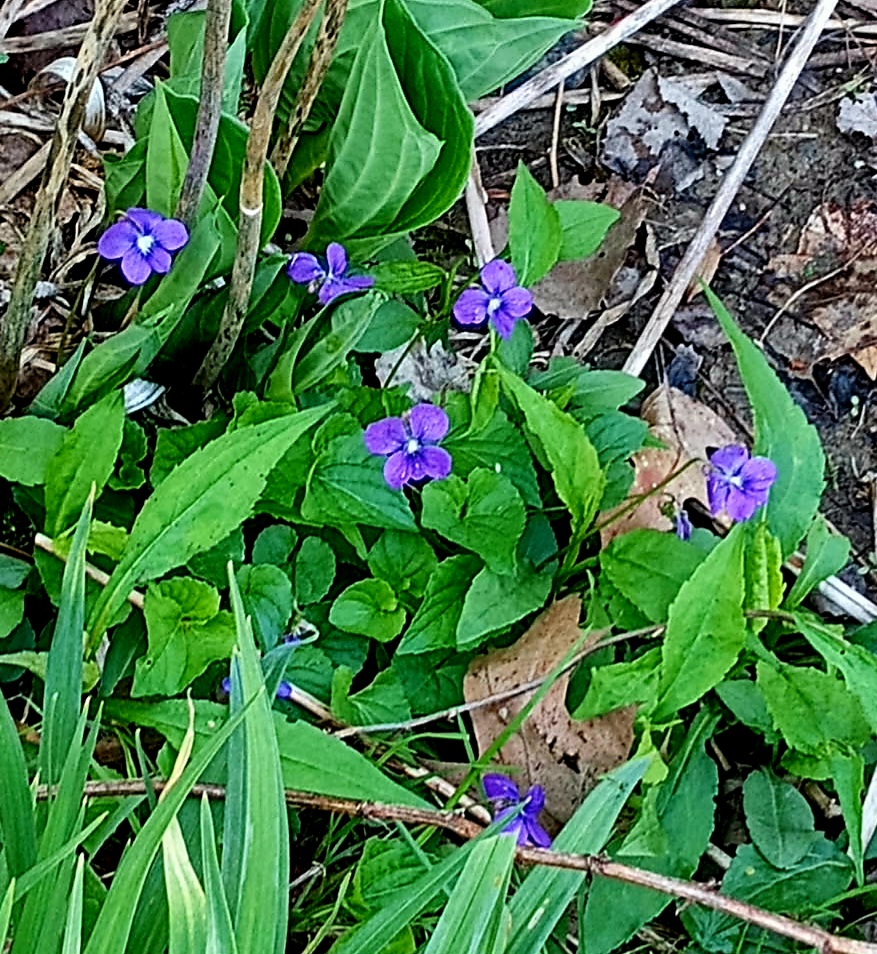
These plants have heart shaped leaves, and each leaf has its own stem. When they bloom, they usually have blue or purple flowers. However, in certain areas they, also, have white flowers.
So, in the photograph below, we see purple wild violets in a flower bed of hostas and some other weeds.
The plants are native to north American and also grow wild in Canada.
Are Wild Violets Edible?
OK, my online research, shows this part is a little tricky because the leaves, stems, and flowers of wild violets are said to be edible. Also, they contain vitamin A and vitamin C.
However, should you eat them? First of all, if you are forging for wild violets some look alike plants are poisonous. It is highly recommended that you only eat them if they are flowering. That way you can tell for sure if it is a wild violet.
Secondly, don’t harvest any wild plants from areas being treated with sprays. Although wild violets are very pretty, in many lawns they are seen as weeds. Weeds are sometimes treated with poisonous sprays.
Thirdly, don’t harvest any plants where you see dogs or other animals about. Same idea, as don’t eat yellow snow.
Uses for Wild Violets
Research shows, people have harvested wild violets for many years to use as both food and for medicinal reasons.
Current days, suggest use the flowers to garnish a cake, dessert or cookies, in salads or even steeped as a mild tea. However, sometimes they are mixed with other teas to make a stronger beverage.
I watched an online video in which the person made a lovely cake. To garnish the cake, she used whipped cream and candied violets.
To make the candied violets, she carefully brushed on an egg mixture to each flower. Secondly, the flowers had white sugar sprinkled on them. When the flowers were dry, she arranged them on the top and sides of a frosted cake.
Ending Notes
Really, I didn’t expect to learn so much about the simple but beautiful wild violet plant.
As always, a Big Thank You to Trail Diva for walking the nature trail and looking for the first flowers of spring. Also, thanks for the photograph and inspiration for today’s blog.
(Do you remember who would always pretend they were Miss Violet or Miss Rosy?)
Resource Sites – Youtube video, Auxhart Gardening and www.almanac.com.